Universal rack interface
19-inch EIA-310 four-post rails with square holes and 450-1000 mm rail adjustment.

North America SME platform · MEC-24-NA
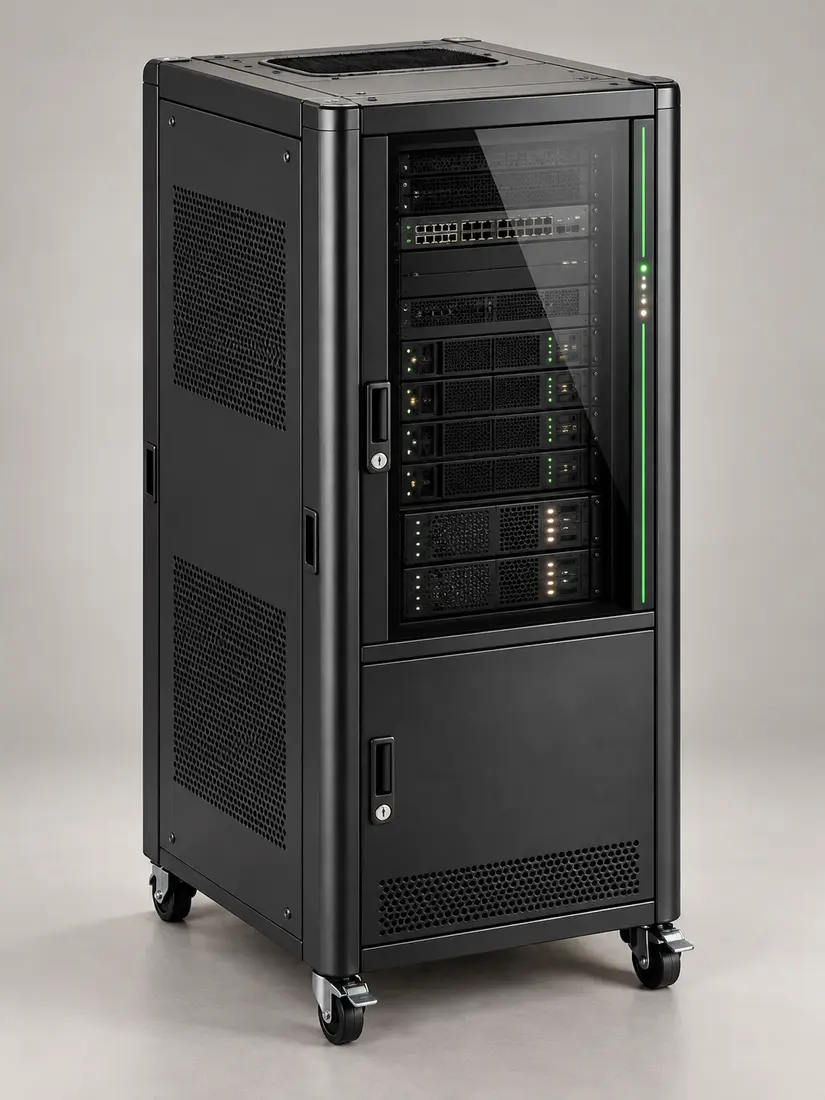
Compact edge AI without data-center complexity. A freestanding, serviceable 24U enclosure for on-premises inference, industrial edge compute and local AI services - designed for both short-depth systems and full-depth 2U GPU servers.
Design decision
A 1200 mm chassis depth leaves a workable envelope for a short-depth 440 mm edge server and for a full-depth 2U GPU server approaching 947 mm, while preserving rear cable-bend and exhaust space.
The 24U layout can be configured as 20U of compute plus a 4U lower power zone, with 0U vertical PDU channels, adjustable front/rear rails and front-to-rear airflow.
This is an SME edge platform, not a replacement for a high-density data-center row. Final node count is governed by measured input power, heat rejection, rail compatibility, weight distribution and local electrical code.
19-inch EIA-310 four-post rails with square holes and 450-1000 mm rail adjustment.
Supports 350-950 mm device depth with planned service and cable-clearance zones.
A lower 4U space can house input distribution, bypass or an optional LFP UPS module.
Perforated intake, unobstructed server airflow and a defined rear exhaust zone.
Equipment compatibility
Board-level AI devices mount on ventilated shelves, while rack servers use approved vendor slide rails. Every final configuration still needs a mechanical, thermal and electrical review.
| Device class | Reference size | MEC-24-NA fit | Integration rule |
|---|---|---|---|
| Jetson / IGX / industrial AI module | Board or compact enclosure; not a native rack device | Yes | Use a lockable ventilated 1U/2U shelf, retention bracket and cable strain relief. |
| Short-depth edge server | Reference: 445 W × 87 H × 440 D mm, 2U | Yes, substantial depth reserve | Use four-post rails and a 0U vertical PDU while maintaining front-to-rear airflow. |
| Full-depth 2U GPU server | Reference: 482 W × 86.8 H × 946.7 D mm | Yes, maximum planned depth class | Validate the exact rail kit; leave rear cable-bend and exhaust clearance. |
| 4U multi-GPU server | Up to 4U and ≤950 mm device depth | Physical fit, limited deployment | Plan no more than 1-2 nodes and select the upgraded electrical and thermal kit. |
Reference dimensions are used only to define a practical compatibility envelope. They do not replace vendor rail testing, thermal validation or final production drawings.
Power architecture
A staged design keeps the entry model practical while providing a defined path for higher-power edge deployments.
| Configuration | Input and continuous planning budget | Recommended payload |
|---|---|---|
| Base - North America single phase | 208/240 V, 30 A locking input; 5.76 kW continuous planning limit | One or two compact GPU servers or several lower-power edge nodes; 0U metered PDU; optional external UPS. |
| Growth - three phase | 208Y/120 V, 30 A three-phase input; 8.6 kW continuous planning limit | Two or three full-depth 2U GPU nodes plus network and local storage where room HVAC is verified. |
| Beyond this platform | More than 8.6 kW sustained, liquid-cooled platforms or unrestricted 8-GPU training servers | Move to a 42U, 750 mm wide data-center cabinet with dedicated cooling and facility engineering. |
Plan PE bonding points, lockable disconnect access and cable strain relief.
Temperature sensors, high-temperature alarms and a monitored controller.
Use listed PDUs, breakers, inlet assemblies and UPS/battery modules.
Cabinet airflow cannot substitute for correctly sized room heat rejection.
Where it fits
The cabinet is intended for secure on-premises inference and industrial edge workloads where a full data-center deployment is unnecessary.
House compact GPU servers, switching and storage for controlled on-premises AI services.
Support video analytics, local data processing and site applications in a serviceable footprint.
Deploy local compute where data handling and response time favor on-site processing.
Integrate inference servers, network equipment and monitored power near the process.
Design boundaries
Prototype quotation should follow an equipment list, rail-kit review, input-power budget and room thermal check.
The 1200 mm cabinet depth is designed around an equipment-depth envelope up to 950 mm. The exact slide rail, bezel, rear cable bend and exhaust clearance still need validation.
The base 208/240 V, 30 A design uses a 5.76 kW continuous planning limit. The 208Y/120 V, 30 A three-phase growth option uses an 8.6 kW planning limit.
No. High-density, liquid-cooled or sustained loads above 8.6 kW should move to a larger data-center cabinet with dedicated facility engineering.
Freeze the server list, vendor rail kits, PDU and inlet, branch circuit, UPS choice, total heat load, room HVAC, acoustic requirement, management interface, certification route and local-code review.
Request a payload review
We will check depth, rails, power, airflow, cable service space and the lower power-zone arrangement before quotation.